Quantitative Aptitude Questions with answers and Solutions for SSC CPO- SI in CPMF Exam. Maths MCQs Mock Test for free online practice of SI CAPF Exam.
Practice Set : Mathematics (Quantitative Aptitude)
Questions : 50
Medium : English
Level : SSC CPO SI Exam
All Type and topic MCQs – Solved by short tricks
Immediate display of Answer and Solution
New Practice of 50 Questions in every attempt
Results
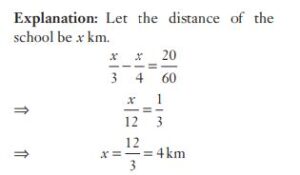
#1. If a boy walks from his house to school at the rate of 4 km per hour, he reaches the school 10 minutes earlier than the scheduled time. However, if he walks at the rate of 3 km per hour, then he reaches 10 minutes late. Find the distance of his school from his house :
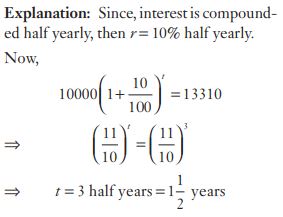
#2. In what time will Rs 10000 amount to Rs 13310 at 20% per annum if compounded half yearly?
#3. Find the largest number of four digits such that on dividing by 15,18, 21 and 24 the remainders are 11, 14, 17 and 20 respectively.

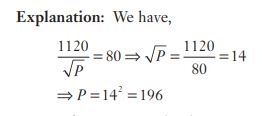
#4. if$ \frac{1120}{\sqrt P} $ =80, then P is equal to
#5. If in a sale, the discount given on a saree is equal to one-fourth the marked price and the loss due to this discount is 15%, then the ratio of the cost price to the selling price is :

#6. A sum of Rs 1600 gives a simple interest of Rs 252 in 2 years and 3 months. The rate of interest per annum is :

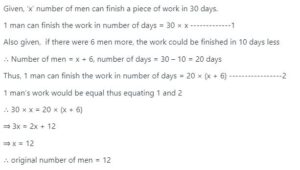
#7. Suppose that ‘x’ number of men can finish a piece of work in 30 days. If there were 6 men more, the work could be finished in 10 days less. The original number of men is :
#8. The average weight of A, B and C is 45 kg. If the average weight of A and B be 40 kg and that of B and C be 43 kg, then the weight (in kg) of B is :

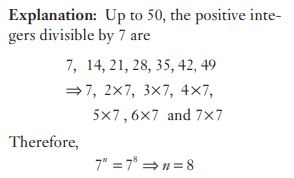
#9. If the product of first 50 positive consecutive integers be divisible by $ 7^n $ , where n is an integer, then the largest possible value of n is :
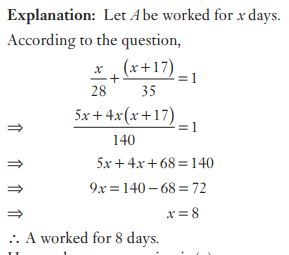
#10. A and B can do a piece of work in 28 and 35 days respectively. They began to work together but A leaves after sometime and B completed the remaining work in 17 days. After how many days did A leave?
#11. The rate of simple interest per annum of bank being decreased from 5% to$ 3\frac12 $ % the annual income of a person from interest was less by Rs 105. The sum deposited at the bank was :

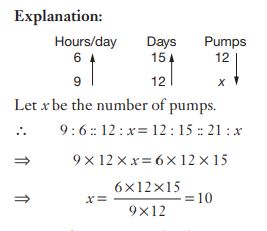
#12. 12 pumps working 6 hours a day can empty a completely filled reservoir in 15 days. How many such pumps working 9 hours a day will empty the same reservoir in 12 days?
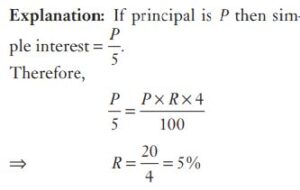
#13. The simple interest on a sum after 4 years is $ \frac15 $ of the sum. The rate of interest per annum is :
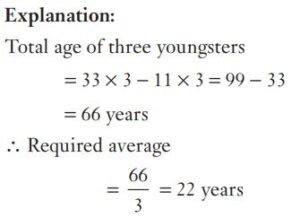
#14. The average age of a cricket team of 11 players is the same as it was 3 years back because 3 of the players whose current average age of 33 years were replaced by 3 youngsters. The average age of the newcomers is :
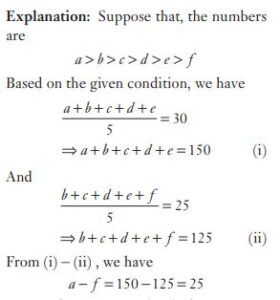
#15. Six numbers are arranged in decreasing order. The average of the first five numbers is 30 and the average of the last five numbers is 25. The difference of the first and the last numbers is :
#16. If the price of petrol be raised by 20%, then the percentage by which a car owner must reduce his consumption so as not to increase his expenditure on petrol is :

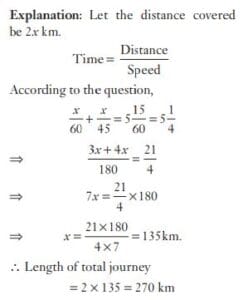
#17. A man travels for 5 hours 15 minutes. If he covers the first half of the journey at 60 km/h and rest at 45 km/h. Find the total distance travelled by him.
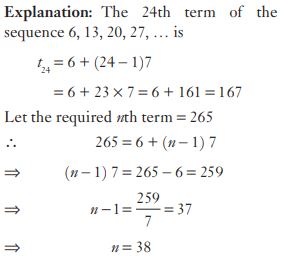
#18. Which term of the sequence 6, 13, 20, 27, … is 98 more than its 24th term?
#19. An old article is available for Rs 12000 at cash payment or is available for Rs 7000 cash payment and a monthly instalment of Rs 630 for 8 months. The rate per cent per annum is :

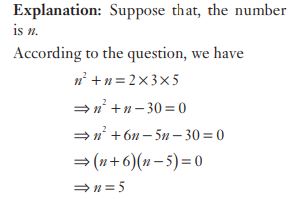
#20. The sum of a natural number and its square equals the product of the first three prime numbers. The number is
#21. A boat goes 6 km an hour in still water, but takes thrice as much time in going the same distance against the current. The speed of the current (in km/hour) is :

#22. Find the least multiple of 23, which when divided by 18, 21 and 24 leaves the remainder 7, 10 and 13 respectively.
LCM of 18, 21 and 24
LCM = 2 × 3 × 3 × 7 × 4 = 504
Now compare the divisors with their respective remainders. We observe that in all the cases the remainder is just 11 less than their respective divisor. So the number can be given by 504 K – 11 Where K is a positive integer
Since 23 × 21 = 483
We can write 504 K – 11
= (483 21) K – 11, = 483 K (21K – 11)
483 K is multiple of 23, since 483 is divisible by 23.
So, for (504K – 11) to be multiple of 23, the remainder (21K – 11) must be divisible by 23.
Put the value of K = 1, 2, 3, 4, 5,6, ….. and so on successively.
We find that the minimum value of K for which (21K – 11) is divisible by 23. is 6, (21 × 6 – 11)
= 115 which is divisible by 23.
Therefore, the required least number
= 504 × 6 – 11 = 3013
#23. Arvind spends 75% of his income and saves the rest. His income is increased by 20% and he increases his expenditure by 10%. Then the increase in savings in percentage is

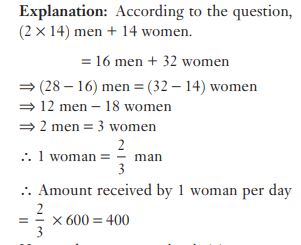
#24. 2 men and 1 woman together can complete a piece of work in 14 days, while 4 women and 2 men together can do it in 8 days. If a man gets Rs 600 per day, how much should a woman get per day?
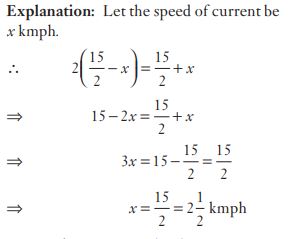
#25. A person can row $ 7\frac12 $ km an hour in still water and he finds that it takes him twice as long to row up as to row down the river. The speed of the stream is :
#26. Out of seven given numbers, the average of the first four numbers is 4 and that of the last four numbers is also 4. If the average of all the seven numbers is 3, then the fourth number is :

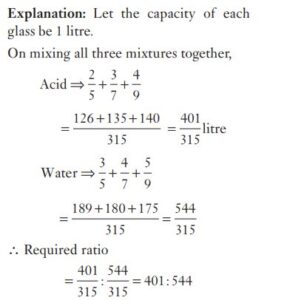
#27. Three glasses are filled with a mixture of acid and water in equal volume. The ratios of acid and water are 2 : 3, 3 : 4 and 4 : 5 respectively. The contents of these glasses are poured in a large vessel. The ratio of acid and water in the large vessel is :
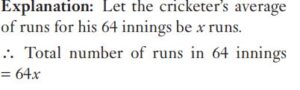
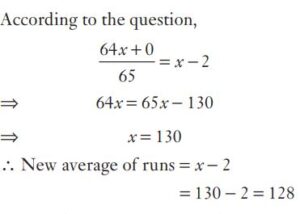
#28. A cricketer had a certain average of runs for his 64 innings. In his 65th innings, he is bowled out for no score on his part. This brings down his average by 2 runs. His new average of runs is :
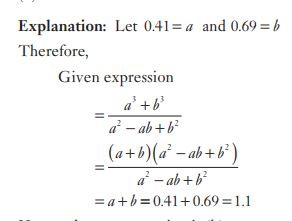
#29. Simplify: $ \frac{0.41\times0.41\times0.41+0.69\times0.69\times0.69}{0.41\times0.41-0.41\times 0.69+0.69+0.69} $
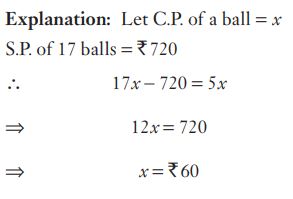
#30. On selling 17 balls at Rs 720, there is a loss equal to the cost price of 5 balls. The cost price (in Rs) of a ball is
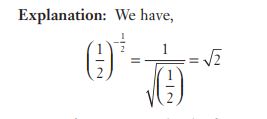
#31. $ (\frac12)^{-\frac12} $ is equal to
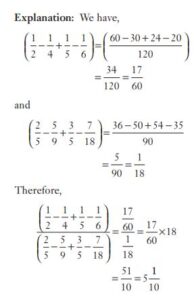
#32. When$ (\frac12-\frac14+\frac15-\frac16 $) is divided by $ (\frac25-\frac59+\frac35-\frac{7}{18} $), the result is
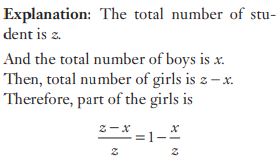
#33. In a class, there are ‘z’ students. Out of them ‘x’ are boys. What part of the class is composed of girls?
#34. If the average of eight consecutive even numbers be 93, then the greatest number among them is :

#35. The average of 5 consecutive natural numbers is m. If the next three natural numbers are also included, then how much more than m will the average of these 8 numbers be?

#36. A farmer travelled a distance of 61 km in 9 hours. He travelled partly on foot at the rate of 4 kmph and partly on bicycle at the rate of 9 kmph. The distance travelled on foot is

#37. The least number which when divided by 4, 6, 8, 12 and 16 leaves a remainder of 2 in each case is :
L.C.M. of 4, 6, 8, 12 and 16 = 48
Required number = 48 2 = 50
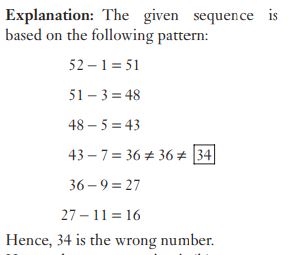
#38. The numbers of the sequence 52, 51, 48, 43, 34, 27, 16 form a pattern. Which of them is misfit in the pattern?
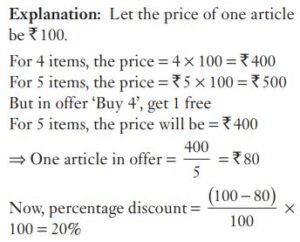
#39. A store has an offer ‘Buy 4 Get 1 Free’. What is the net percentage of discount?
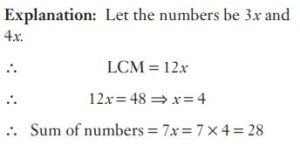
#40. The ratio of two numbers is 3 : 4 and their LCM is 48. The sum of the two numbers is :
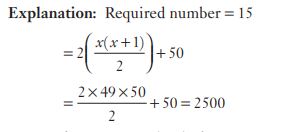
#41. 1 + 2 + 3 + … + 49 + 50 + 49 + 48 + … + 3 + 2 + 1 is equal to
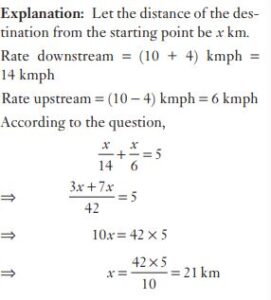
#42. A man goes downstream with a boat to some destination and returns upstream to his original place in 5 hours. If the speed of the boat in still water and the stream are 10 km/hr and 4 km/hr respectively, then the distance of the destination from the starting place is :
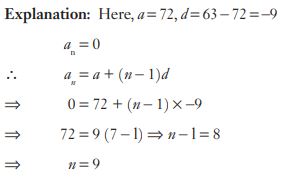
#43. Which term of the series 72, 63, 54 … is zero?
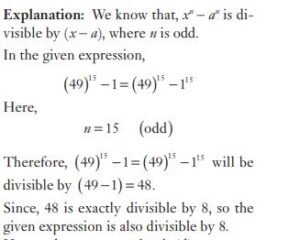
#44. (49)15 – 1 is exactly divisible by
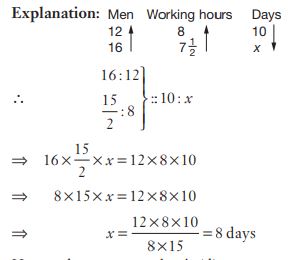
#45. If 12 men working 8 hours a day complete the work in 10 days, how long would 16 men working $ 7\frac12 $ hours a day take to complete the same work?
#46. The average of three consecutive odd numbers is 12 more than one third of the first of these numbers. What is the last of the three numbers?
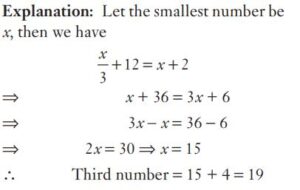
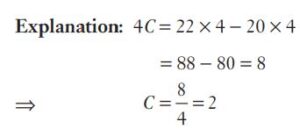
#47. If the mean of 4 observations is 20, when a constant ‘C’ is added to each observation, the mean becomes 22. The value of C is
#48. A train passes a platform 90 metre long in 30 seconds and a man standing on the platform in 15 seconds. The speed of the train is :

#49. A merchant sold an article for Rs 75 at a profit per cent equal to its cost price. The cost price of the article was :

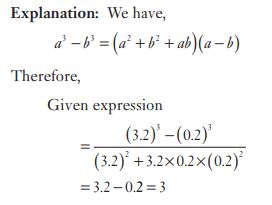
#50. The value of $ \frac{(3.2)^3-0.008}{(3.2)^2 + 0.64 +0.04} $is