Welcome to your Reasoning Mock Test (English) -1
5.
In the following question, four number pairs are given. In each pair the number on left side of (–) is related to the number of the right side of (–) with some Logic/Rule /Relation. Three pairs are similar on basis of same Logic/Rule/Relation. Select the odd one out from the given alternatives. (NOTE: Operations should be performed on the whole numbers, without breaking down the numbers into its constituent digits. E.g.13 – Operations on 13 such as adding /subtracting /multiplying etc. to 13 can be performed. Breaking down 13 into 1 and 3 and then performing mathematical operations on 1 and 3 is not allowed)
8.
Which of the following terms will replace the question mark (?) in the given series ?
HKOE, KNOE, ?, QTOE, TWOE
9.
In the following question, select the missing number from the given series.
129, 126, 123, 120, 117, ?
10.
In a examination hall seven students Aditi, Cindy, Jeanie, Kirti, Niti, Preeti, and Sweety are sitting in a row facing North but not necessarily in the same order. Cindy sits third to the right of Sweety, Aditi and Preeti are immediate neighbours of Cindy, More than two persons sit between Preeti and Sweety, Jeanie is the only neighbour of Niti Jeanie sits to the right of Aditi. What is the position of Nitit with respect to Kirti ?
11.
If the given sheet is folded to form a cube, which of the given figures is/are possible ?
(The numbers are shown to indicate the sides only.)
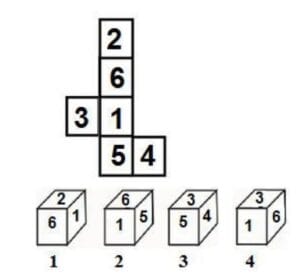
15.
Select the option that represents the letters which, when sequentially placed from left to right in the blanks below, will complete the letter series.
_L_ _ K S_ T U _ S L _ _ K
16.
Which of the following numbers will replace the question mark (?) in the given series ?
473, 517, 561, ?, 649, 693
18.
Which of the following numbers will replace the question mark (?) in the given series?
286, 303, 320, 371, 422, 507, ?
20.
In the following question below are given some statements followed by some conclusions based on those statements. Taking the given statements to be true even if they seem to be at variance from commonly known facts. Read all the conclusions and then decide which of the given conclusion logically follows the given statements. Statements:
I. All Z are D.
II. No Y is Z.
Conclusion:
I. Some D are not Y.
II. Some Z are not Y.
III. Some D are Z.