Quantitative Aptitude Questions with Answers and Solution for SSC CGL- Mock Test of Maths MCQs set for online practice of upcoming Competitive exams.
Subject : Quantitative Aptitude (Mathematics)
Medium : English
Level : SSC CGL
All type Questions with Solution
As per latest exam pattern and syllabus
Set of 25 Questions – New Questions practice Set in Every Attempt
Results
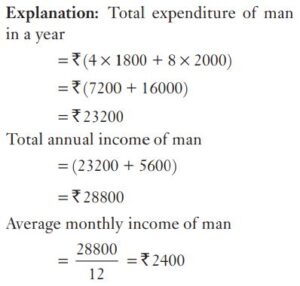
#1. A man spends Rs. 1800 monthly on an average for the first four months and Rs. 2000 monthly for the next eight months and saves Rs. 5600 a year. His average monthly income is :
#2. The average salary of all the workers in a workshop is Rs. 8000. The average salary of 7 technicians is Rs.12,000 and the average salary of the rest is Rs.6000. The total number of workers in the workshop is :

#3. A boat goes 12 km downstream and comes back to the starting point in 3 hours. If the speed of the current is 3 km/hr, then the speed (in km/hr) of the boat in still water is :

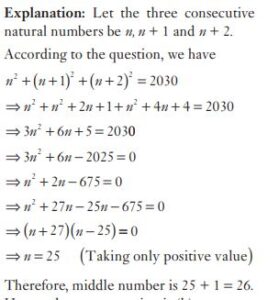
#4. The sum of the squares of three consecutive natural numbers is 2030. Then, what is the middle number?
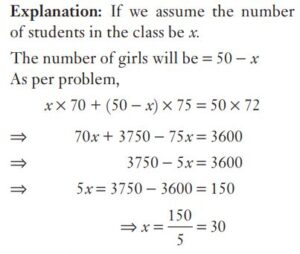
#5. The average marks of 50 students in a class is 72. The average marks of boys and girls in that subject are 70 and 75 respectively. The number of boys in the class is :
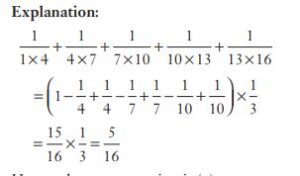
#6. Find the sum of the first five terms of the following series.$ \frac{1}{1\times4}+\frac{1}{4\times7}+\frac{1}{7\times10} $ +………+…….
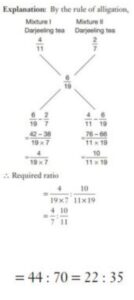
#7. In two blends of mixed tea, the ratios of Darjeeling and Assam tea are 4 : 7and 2 : 5. The ratio in which these two blends should be mixed to get the ratio of Darjeeling and Assam tea in the new mixture as 6 : 13 is :
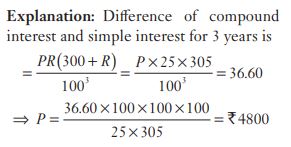
#8. If the difference between the compound interest and simple interest on a sum at 5% rate of interest per annum for three years is Rs 36.60, then the sum is :
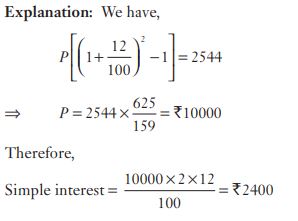
#9. If the compound interest on a certain sum for two years at 12% per annum is Rs 2544, the simple interest on it at the same rate for 2 years will be :
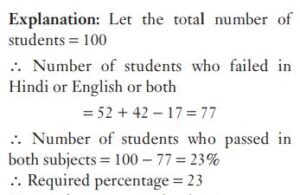
#10. In an examination, 52% students failed in Hindi and 42% in English. If 17% failed in both the subjects, what percentage of students passed in both the subjects?
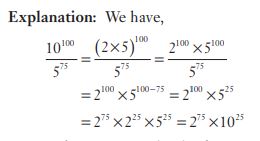
#11. The quotient when $ 10^{100} $ is divided by $ 5^{75} $ is
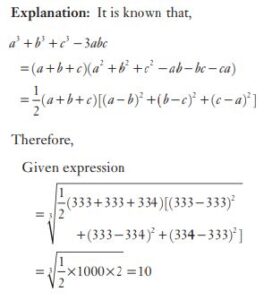
#12. $ \sqrt[3]{(333)^3+(333)^3+(334)^3 -3\times333\times333\times334} $ is equal to
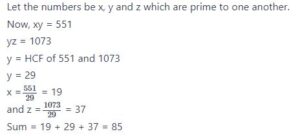
#13. Three numbers which are coprime to one another are such that the product of the first two is 551 and that of the last two is 1073. The sum of the three numbers is :
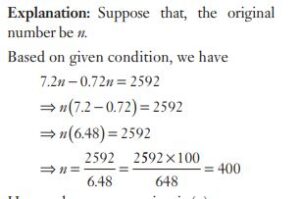
#14. Instead of multiplying a number by 0.72, a student multiplied it by 7.2. If his answer was 2592 more than the correct answer, then the original number was :
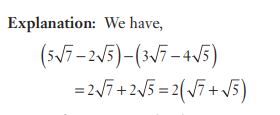
#15. By how much does $ 5\sqrt7-2\sqrt5 $ exceed $ 3\sqrt7-4\sqrt5 $ ?
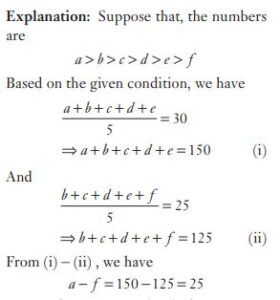
#16. Six numbers are arranged in decreasing order. The average of the first five numbers is 30 and the average of the last five numbers is 25. The difference of the first and the last numbers is :
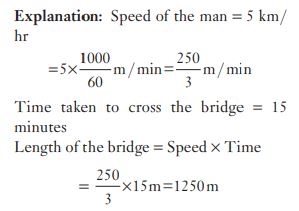
#17. A man walking at the rate of 5 km/hr crosses a bridge in 15 minutes. The length of the bridge (in metres) is
#18. The ratio of cost price and selling price is 5 : 4, the loss percent is :

#19. Ramesh bought 10 cycles for Rs 500 each. He spent Rs 2000 on the repair of all cycles. He sold five of them for Rs 750 each and the remaining for Rs 550 each. Then the total gain or loss % is :

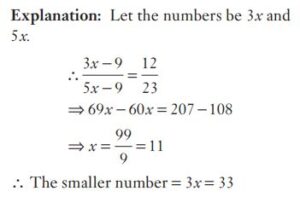
#20. Two numbers are in the ratio 3 : 5. If 9 is subtracted from each, then they are in the ratio 12 : 23. Find the smaller number.
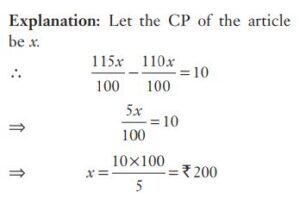
#21. The difference between the selling prices of an article at a profit of 15% and at a profit of 10% is Rs 10. The cost price of the article is
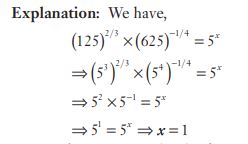
#22. If $ (125)^{2/3}\times (625)^{1/4} = 5^{x} $, then the value of x is
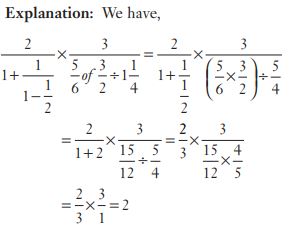
#23. Find the value of $ \frac{2}{1+\frac{1}{1-\frac{1}{2}}} \times\frac{3}{\frac56 \text{of} \frac{3}{2} \div 1\frac14} $
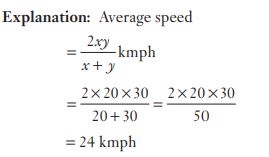
#24. A train runs from Howrah to Bandel at an average speed of 20 km/hr and returns at an average speed of 30 km/hr. The average speed (in km/hr) of the train in the whole journey is :
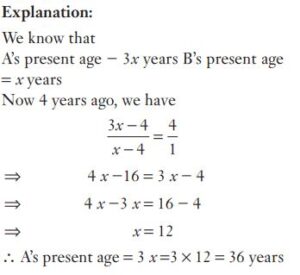
#25. The ratio of the ages of A and B at present is 3 : 1. Four years earlier the ratio was 4 : 1. The present age of A is :
Thank you so much