SSC CHSL Quantitative Aptitude (Basic Arithmetic Skill) Questions with answers and Solutions for free online practice.
Mock Test : Maths (Quantitative Aptitude) MCQs
Exam : SSC CHSL
Medium : English
Questions : 25 ( New practice set in every attempt)
All questions are solved with short tricks
You can check the answer and solution of every question.
Results
#1. In a test a student got 30% marks and failed by 25 marks. In the same test another student got 40% marks and secured 25 marks more than the essential minimum pass marks. The maximum marks for the test were

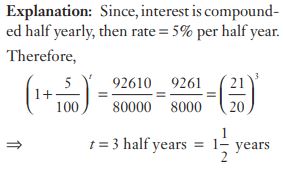
#2. The time in which Rs 80000 amounts to Rs 92610 at 10% p.a. compound interest, interest being compounded semi-annually is :
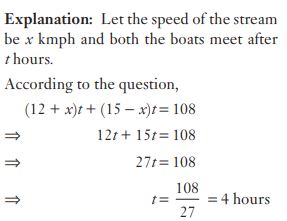
#3. Two boats A and B start towards each other from two places, which is 108 km apart. Speed of the boat A and B in still water are 12 km/hr and 15 km/hr respectively. If A proceeds down and B up the stream, they will meet after how many hours?
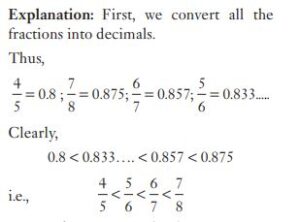
#4. Arrange  in the ascending order.
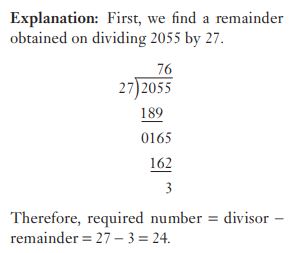
#5. The least number that should be added to 2055, so that the sum is exactly divisible by 27 is :
#6. A sum of money becomes  of itself in 3 years at a certain rate of simple interest. The rate per annum is :

#7. The least number which when divided by 4, 6, 8, 12 and 16 leaves a remainder of 2 in each case is :
L.C.M. of 4, 6, 8, 12 and 16 = 48
Required number = 48 2 = 50
#8. An old article is available for Rs 12000 at cash payment or is available for Rs 7000 cash payment and a monthly instalment of Rs 630 for 8 months. The rate per cent per annum is :

#9. At an election there were two candidates. A candidate got 38% of votes and lost by 7200 number of votes. The total number of valid votes were :

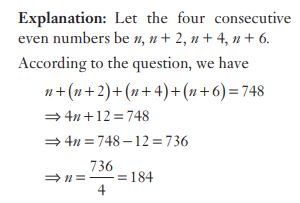
#10. The sum of four consecutive even numbers is 748. The smallest among them is
#11. If Rahim deposited the same amount of Rs x in a bank at the beginning of successive 3 years and the bank pays a simple interest of 5% per annum, then the amount at his credit at the end of 3rd year will be :

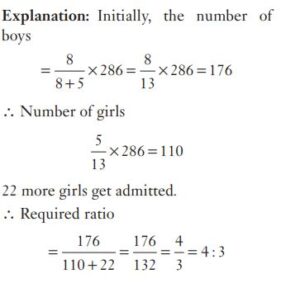
#12. In a school having roll strength 286, the ratio of boys and girls is 8 : 5. If 22 more girls get admitted into the school, the ratio of boys and girls become
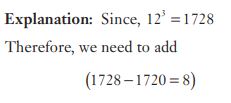
#13. The least number, that must be added to 1720 so as to obtain a perfect cube is :
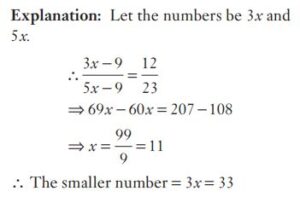
#14. Two numbers are in the ratio 3 : 5. If 9 is subtracted from each, then they are in the ratio 12 : 23. Find the smaller number.
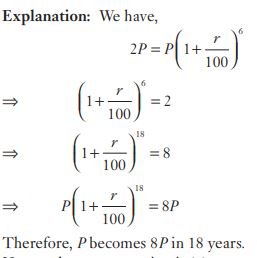
#15. A sum of money invested at compound interest doubles itself in 6 years. At the same rate of interest it will amount to eight times of itself in :
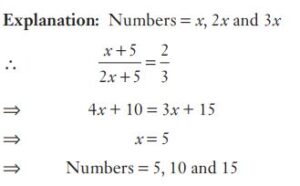
#16. Three numbers are in the ratio 1 : 2 : 3. By adding 5 to each of them, the new numbers are in the ratio 2 : 3 : 4. The numbers are:
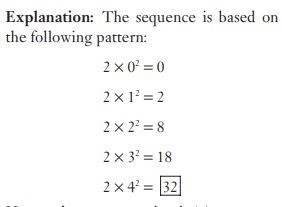
#17. The missing number of the sequence 0, 2, 8, 18,__, 50 is :
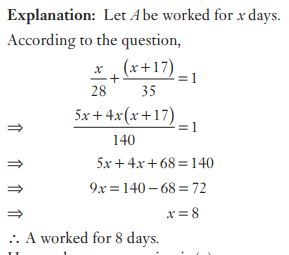
#18. A and B can do a piece of work in 28 and 35 days respectively. They began to work together but A leaves after sometime and B completed the remaining work in 17 days. After how many days did A leave?
#19. A tradesman marks his goods at 20% above the cost price. He allows his customer a discount of 8% on marked price. Find out his profit percent.

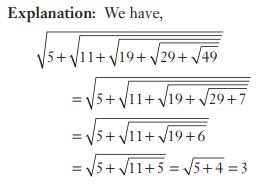
#20. the simplified value of  is
is
#21. A reduction of 25% in the price of rice enables a person to buy 10 kg more rice for Rs.600. The reduced per kg price of rice

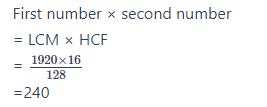
#22. The LCM of two numbers is 1920 and their HCF is 16. If one of the number is 128, find the other number.
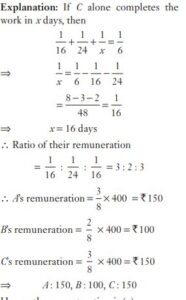
#23. A can do a piece of work in 16 days and B in 24 days. They take the help of C and they together finish the work in 6 days. If the total remuneration for the work is Rs 400. The amount (in Rs ) each will receive, in proportion, to do the work is :
#24. The average of 30 numbers is 12. The average of the first 20 of them is 11 and that of the next 9 is 10. The last number is :
Explanation: Last number :
= 30 × 12-20 × 11 − 9 × 10
= 360 − 220 − 90
= 360 − 310 = 50
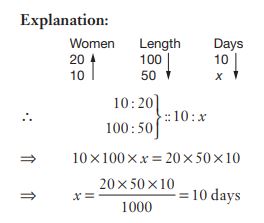
#25. If 20 women can lay a road of length 100 m 10 days. Then 10 women can lay the same road of length 50 m in :